
TRIAXYS™
Directional Wave Buoy
System
Our TRIAXYS™ Directional Wave Buoy plays a critical role in our Dynamic Under Keel Clearance System. This allows the safe transit of deep-draft ships, or ships in heavy weather, when navigating the harbour entrance.
The Wave Rider Buoy is designed and manufactured in Canada by Axys International Inc and the buoy is called TRIAXYS™ Directional Wave Buoy.
The buoy precisely measures directional waves, capable of producing direction, heights, periods and energy data. The data transmitted from the buoy can include wave statistics, HNE (Heave, North and East Displacements), Mean Dir (Wave Direction and energy as a function of frequency), directional and non-directional wave spectra, sea temperature, buoy power status, position and alarm messages.
The buoy transmits the data back to Northport every 30 minutes by GPRS (cellphone network) or if this fails via VHF as a backup system.
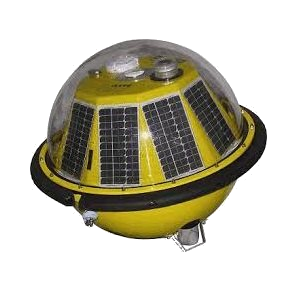
Compact and rugged, the WRB can withstand the rigors of being deployed in such a wild environment, where it can withstand n excess of 100kn winds and swells of 12m+ and submergence of up to 8m.The buoy’s spun stainless steel hull has a high strength to weight ratio and corrosion resistance, and provides secure mooring and lifting points.
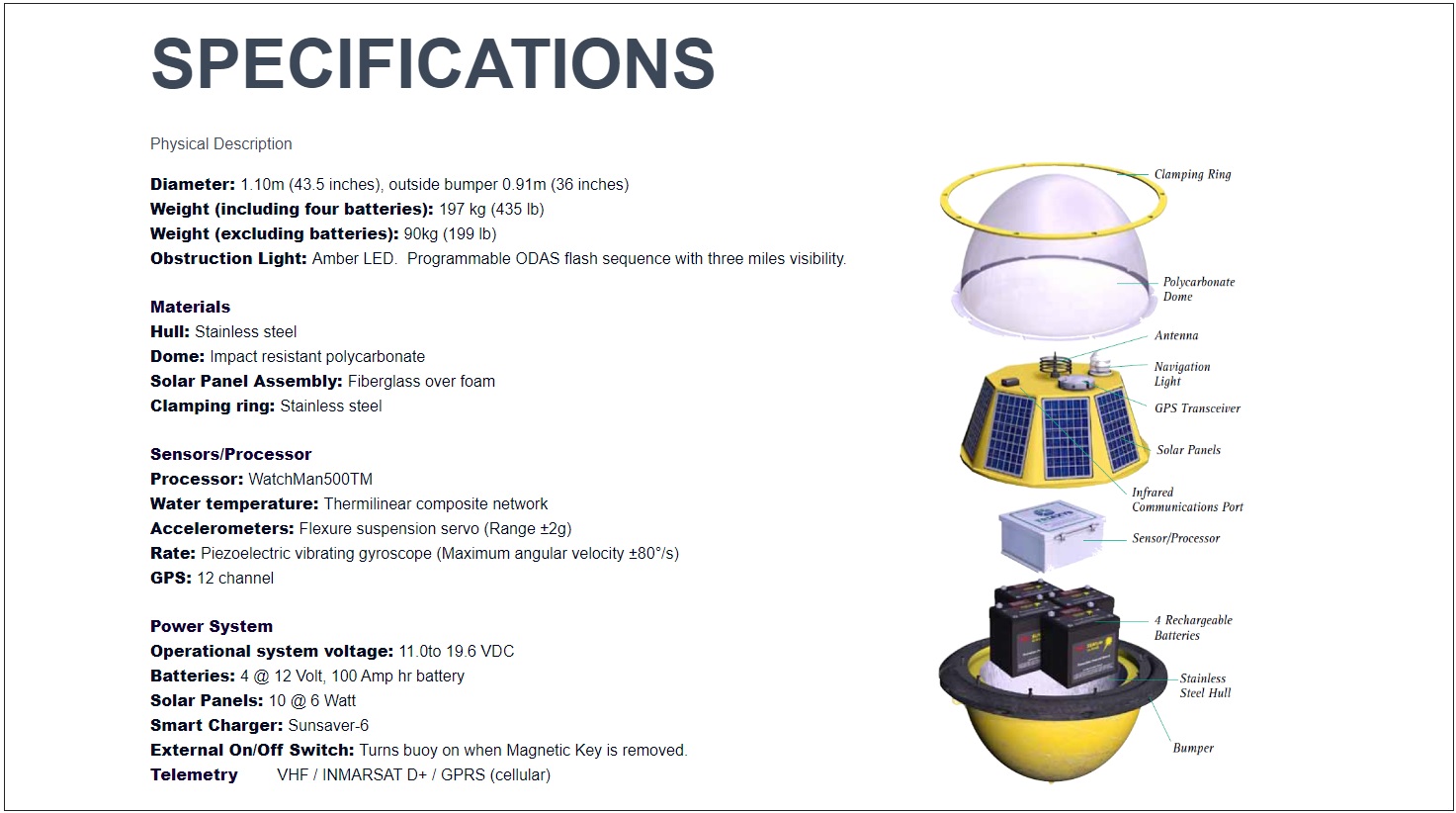
The clear dome allows sunlight to reach the solar panels, while maintaining a low profile and impact resistance. The buoy is solar powered with 4x 10⁴Ahr gel rechargeable batteries to reduce annual operating costs.
The heart of the TRIAXYS™ Directional Wave Buoy is developed from the AXYS WatchMan500™ controller, which integrates sensor systems and provides on-board data processing, data logging, telemetry, and diagnostic/set-up routines. A full directional wave spectrum is computed by the CHC maximum entropy method. Mean wave direction and spreading width are computed as functions of frequency. The software also performs a zero-crossing analysis to compute various time-domain wave parameters. The on-board computer uses an iterative algorithm based on Fast Fourier Transform analysis to solve the full non-linear equations of motion in six degrees of freedom, as measured by accelerometers and angular rate gyros. The buoy is capable of accurate motion data for roll and pitch angles up to 60 degrees. Surge and sway velocities measure wave kinematics that define directional wave properties.
The sensor unit is comprised of three accelerometers, three rate gyros, a Fluxgate compass and the proprietary TRIAXYS™ Processor.
The buoy is moored using a special mooring set-up unlike conventional navigation aid moorings. The key feature required is the need to de-couple the mooring from the buoy to allow unrestricted buoy motions in wave fields. The de-coupling is accomplished by operating the buoy in an untethered free-floating configuration. The mooring is composed of a special extruded 32 mm (1.25”) rubber cord, 15 m in length, terminated with stainless steel compression fittings. The elastic nature of the rubber cord allows the buoy to follow waves in an unrestricted fashion. The buoy is the tethered to a main mooring line, subsurface floats before attached to its mooring.
Watch Out for Me and Keep Clear !!
The two Wave Rider Buoy's (WRB) are a vital piece of equipment for shipping operations at Marsden Point.
The WRB's play a key role in the ports Dynamic Under Keel Clearance system (DUKC). This system is used to determine if a ship can safely transit the harbour, when deep draft or in heavy weather.
It is extremely important that all vessels keep a good lookout for these buoy and stay well clear, the area is marked as prohibited by the Harbourmaster.
These buoy's is very robust and able to withstand in excess of 50kn winds and swells of 10m +. A maximum wave height of 8.7m was recorded in the 3rd March 2012 storm.
Even though these buoy's are designed for the extreme elements of the open ocean, it cannot with stand contact with vessels to its dome or fouling of its delicate mooring system by anchors. As shown in the photograph below the mooring consists of a specially designed 15m bungee cord which aids in the measurement of the conditions, this bungee can be easily damaged by fishing hooks or moorings.
Please keep a good lookout for these buoy's and stay well clear.
Any Damage to these buoy's or their moorings could result in
a vessel being placed into unnecessary danger.
Northport 09 432 5018 (24hrs)